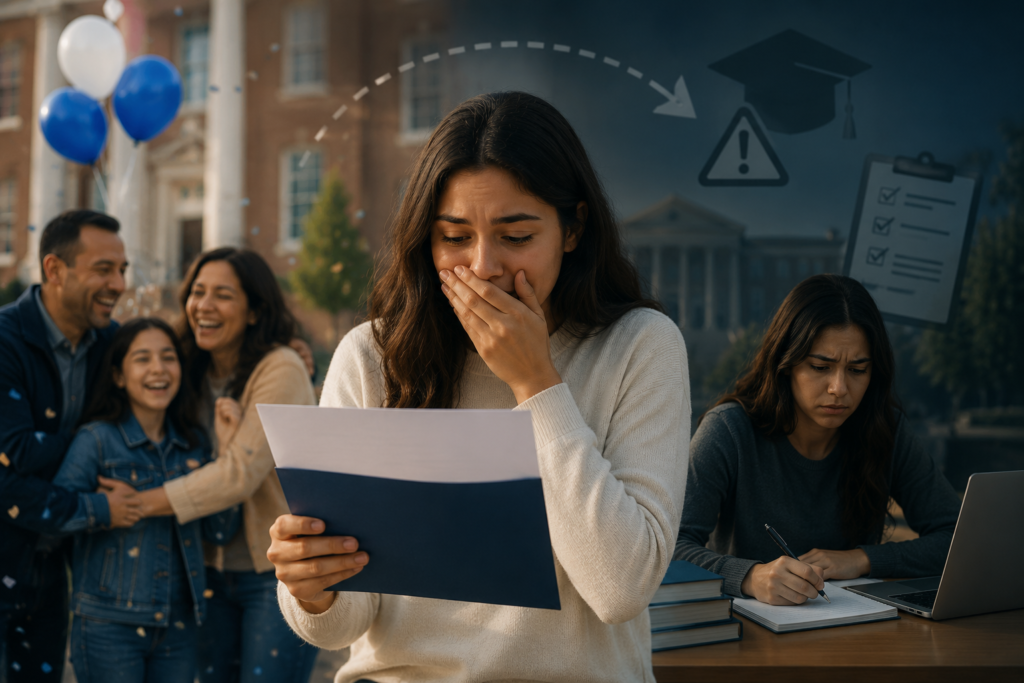


A student announces an interest in medicine, and suddenly the checklist appears: advanced science courses, hospital volunteering, shadowing, research, a medical summer program, a leadership title, and as many healthcare-related activities as possible.
That pressure can make high school feel like the first round of medical school admissions. However, the pre-med journey is a long one, and trying to prove everything too early can lead to superficial involvement, unnecessary stress, and a résumé that says “busy” without showing genuine purpose.
Admittedly’s Pre-Med Pathways Guide takes a more sustainable approach. It emphasizes what matters in high school for future pre-med students: academic preparation, meaningful exploration, real-world experiences, and long-term development without burnout or résumé stacking.
The most important question is not, “How many medical activities can a student collect?” It is: “What kind of preparation will help this student understand healthcare, develop the right habits, and build a credible foundation over time?”
For families who need to connect academic decisions, activities, college goals, and application positioning, Admittedly’s personalized college admissions strategy provides a broader framework.
Pre-Med Is a Pathway, Not a High School Major
“Pre-med” is generally not a college major or a single high school track. It is a long-term direction that can lead toward medical school and other healthcare careers. Students can eventually major in biology, chemistry, psychology, engineering, humanities, or many other fields while completing the prerequisites required by their target medical schools.
That flexibility matters. A student does not need to look like a medical student at age fifteen. Instead, high school should help the student build curiosity, academic discipline, communication skills, service orientation, and a realistic understanding of healthcare.
Medical school preparation becomes more formal during college. For example, Yale School of Medicine lists foundational college-level areas such as biology, chemistry, organic chemistry, biochemistry, physics, and statistics among its requirements. Those requirements should not be treated as a high school checklist. Rather, they illustrate why a strong high school foundation in science, mathematics, reading, and writing can support later choices.
The best high school plan creates options. It does not force a teenager to make every decision about a medical career before gaining enough experience to understand what the work involves.
Academic Readiness Comes Before the Résumé
For future pre-med students, academic preparation is the foundation. Activities cannot compensate for a weak or unsustainable academic record, and advanced courses should be selected for learning rather than for appearance alone.
A thoughtful high school schedule may include challenging coursework in biology, chemistry, physics, mathematics, and English when available and appropriate. However, the exact sequence depends on the school, the student’s preparation, and the demands of the rest of the schedule.
The goal is not to take every advanced course simultaneously. Instead, students should develop the ability to understand complex material, analyze evidence, communicate clearly, and manage sustained effort.
The College Board’s guidance on choosing high school courses can help families understand how course selection fits into broader high school planning. It should be used as a starting point, not as a universal prescription.
The Academic Foundation to Build
| Area | What the student should develop |
| Biology and chemistry | Comfort with scientific concepts, evidence, systems, and laboratory thinking |
| Physics | Quantitative reasoning and the ability to understand forces, energy, and physical systems |
| Mathematics | Confidence with data, patterns, modeling, and increasingly complex problems |
| English and writing | Clear communication, reading comprehension, and the ability to explain ideas precisely |
| Social sciences and humanities | Perspective, ethical reasoning, cultural awareness, and understanding of people |
Strong science preparation matters, but so does the ability to think beyond science. Healthcare involves patients, families, ethics, communication, inequality, institutions, and difficult decisions. Consequently, a well-rounded academic foundation can be more valuable than a transcript built around science labels alone.
Stop Treating Medical Activities Like Collectible Badges
Hospital volunteering, physician shadowing, research, health-related internships, and medical summer programs can be meaningful. Nevertheless, their value depends on the student’s level of engagement and what the experience actually teaches.
A short, highly selective program does not automatically create a stronger profile than a consistent service commitment in the student’s community. Similarly, shadowing a physician for a few hours can offer useful perspective, but it does not prove that the student understands medicine or is prepared for a healthcare career.
The difference is depth. A student who volunteers regularly, learns how a care environment works, reflects on patient needs, and continues serving over time may gain more than a student who collects several disconnected experiences for a résumé.
What Meaningful Exploration Can Look Like
A student may explore medicine through:
•service at a hospital, clinic, nursing home, hospice, or community organization;
•research in biology, public health, psychology, neuroscience, or another relevant field;
•a health education or public-health project;
•work with underserved communities;
•conversations with healthcare professionals;
•caregiving or family responsibilities;
•first-aid, emergency-response, or health-science courses; or
•independent reading and reflection about a healthcare issue.
The list is intentionally broad. Not every student has access to a hospital, laboratory, or prestigious summer program. A strong strategy works with the opportunities that are realistically available.
Research Is Valuable—But It Is Not a Universal Requirement
Research can help students understand how scientific questions are developed, tested, revised, and communicated. It may also introduce students to laboratory work, public health, data analysis, or clinical questions.
However, high school students should not assume that a prestigious research placement is required to demonstrate interest in medicine. The Stanford Institutes of Medicine Summer Research Program is an official example of hands-on research exposure for high school students, including work under the guidance of researchers. It is an opportunity, not a universal admissions expectation.
Research can also happen in smaller settings. A student might design an independent investigation, analyze public health data, assist a teacher, participate in a school project, or explore a question through sustained reading and experimentation. The scale may vary, but the habits are similar: asking a thoughtful question, working carefully, interpreting evidence, and learning from results.
The strongest research experience is not necessarily the one with the most impressive name. It is the one in which the student can explain what was studied, what was difficult, what changed, and what the experience revealed about the student’s interests.
The Skills Behind a Strong Future Physician
Medicine requires far more than science knowledge. Future physicians must communicate with patients, collaborate with teams, reason through incomplete information, respond to feedback, act ethically, and remain dependable under pressure.
The Association of American Medical Colleges’ premed competency framework organizes preparation around professional, science, and thinking-and-reasoning competencies. These categories reinforce an important point: pre-med development is broader than collecting clinical exposure.
Competencies High School Students Can Begin Developing
| Competency | How it may develop in high school |
| Scientific inquiry | Laboratory work, research, careful reading, and asking testable questions |
| Critical thinking | Evaluating evidence, comparing explanations, and solving unfamiliar problems |
| Communication | Writing clearly, listening carefully, presenting ideas, and adapting explanations |
| Service orientation | Sustained involvement in community work that responds to real needs |
| Teamwork | Collaborating with classmates, teammates, supervisors, or community partners |
| Reliability | Showing up consistently, completing responsibilities, and following through |
| Cultural awareness | Learning from people whose experiences differ from the student’s own |
These competencies do not need to be announced as “pre-med activities.” They can develop through athletics, employment, family responsibilities, arts, community service, academic projects, and ordinary commitments handled with seriousness.
The Burnout Problem Nobody Includes on the Checklist
Because the path to medical school is long, sustainability is not a minor concern. Students who fill every semester with advanced courses, research, volunteering, competitions, leadership roles, and summer programs may create a schedule that is impossible to maintain.
Burnout can weaken academic performance, reduce the quality of activities, and make the student lose the curiosity that initially made medicine attractive. Moreover, a crowded résumé does not necessarily communicate maturity or commitment.
A better plan includes boundaries. Students need time to sleep, recover, pursue non-medical interests, maintain relationships, and discover whether medicine genuinely fits their values and strengths.
That is why the Pre-Med Pathways Guide focuses on preparation without burnout and résumé stacking. The guide helps families think in terms of sustainable development rather than premature competition.
What If a Student Does Not Have Traditional Medical Opportunities?
Access to medical experiences varies widely. Some students live near hospitals and research universities. Others live in areas with limited transportation, few formal programs, or significant family and work responsibilities.
Admissions readers evaluate students in context. Therefore, the absence of a hospital internship does not automatically weaken a student’s potential. The more useful question is how the student used the opportunities that were available.
A student who works after school, cares for a family member, translates for relatives, supports a community organization, or studies public health independently may be developing relevant skills even without a formal medical title. These experiences should not be forced into a medical narrative. Instead, their meaning should be understood honestly.
The U.S. Bureau of Labor Statistics overview of physicians and surgeons provides broader context about the work, education, and responsibilities associated with the profession. That perspective can help families move beyond the narrow idea that medicine only means hospital shadowing.
The Difference Between Exploration and Performance
Exploration asks, “What does this field involve, and does it fit the student?” Performance asks, “How will this look on an application?”
Both questions may appear during the college process, but exploration should come first. Students who begin with genuine curiosity are more likely to choose experiences that teach them something meaningful. Students who begin with résumé optics may select activities that look impressive but provide little understanding.
A strong pre-med profile develops through a pattern of choices:
1.The student explores a question or area of healthcare.
2.The student learns from the experience.
3.The student identifies what remains interesting or unresolved.
4.The student pursues greater depth or responsibility.
5.The student reflects on how the experience changed the student’s perspective.
This pattern is more credible than a list of disconnected medical activities. It also gives the student stronger material for future college essays, interviews, and conversations with advisors.
Families seeking help connecting those choices to a broader admissions plan can explore Admittedly’s college admissions consulting services.
Build the Pre-Med Preparation Timeline Before Senior Year
A pre-med pathway should evolve over time. The timeline below offers a planning framework rather than a rigid set of requirements.
| Stage | Strategic focus |
| Before high school | Learn about course placement, science sequencing, school opportunities, and the student’s initial interests |
| Ninth grade | Establish strong academic habits and explore science, service, and community activities without overcommitting |
| Tenth grade | Review the academic trajectory, deepen one or two interests, and identify realistic opportunities for research or service |
| Junior year | Continue rigorous coursework, pursue meaningful responsibility, and reflect on whether medicine remains a genuine goal |
| Junior summer | Consider research, service, coursework, employment, caregiving, or another experience that supports growth and reflection |
| Senior fall | Present the student’s preparation accurately, connect activities to the application narrative, and confirm college requirements |
The timeline should remain flexible. A student who discovers an interest in medicine later can still build meaningful preparation. Conversely, a student who began early may decide that another healthcare or scientific path is a better fit.
Pre-Med Pathway Questions, Answered
No. High school students do not need to complete a fixed list of medical activities. Coursework, service, research, communication, leadership, family responsibilities, and genuine exploration can all contribute to preparation. The strongest choices are meaningful, sustainable, and appropriate for the student’s access and stage of development.
Hospital volunteering and shadowing can provide useful exposure, but they are not universal requirements and may not be available to every student. A consistent community-service commitment, public-health project, caregiving responsibility, or conversation with healthcare professionals can also help a student learn about service and patient-centered work.
Research is valuable but not mandatory for every high school student. It can develop scientific inquiry and evidence-based reasoning, yet meaningful research opportunities vary by location, eligibility, and access. A smaller independent investigation or sustained academic project may be more appropriate than chasing a prestigious program solely for its name.
Families should prioritize academic mastery, sustainable commitments, rest, and genuine exploration. A personalized plan can help identify which activities are worth pursuing, which opportunities are realistic, and where the student’s current path may need adjustment. The objective is long-term development, not an overloaded résumé.
The Bigger Truth About Pre-Med Preparation
The strongest future pre-med students are not necessarily the ones who start collecting medical activities first. They are the ones who build a durable foundation: academic discipline, curiosity, service, communication, scientific reasoning, and the ability to learn from real experiences.
Medicine is a marathon, not a sprint. Consequently, high school should be a time to prepare thoughtfully, explore honestly, and develop habits that can support the many years of education ahead.
The right path will look different for every student. A meaningful community commitment may matter more than a short-term program. A challenging science course may matter more than another club. A family responsibility may reveal more about reliability and empathy than a formal title.
The goal is not to make a teenager look like a finished physician. The goal is to help the student discover whether medicine is the right direction and, if it is, begin building the foundation to pursue it with purpose.
Ready to Build a More Sustainable Pre-Med Plan?
Generic advice can list activities. It cannot determine which academic choices, experiences, and commitments fit one student’s context.
Families can start with Admittedly’s Pre-Med Pathways Guide, created for high school students and families who want to understand what matters without burnout or résumé stacking.
For a more individualized assessment of goals, academics, activities, and next steps, families can book a Free Strategy Call with Admittedly.